
A smarter way to scale marketing: fractional vs. in-house [with real numbers].
Marketing performs best when it’s treated as a variable
investment & not a fixed overhead cost.
The “one size fits all” approach just doesn’t work anymore.
When leaders talk about “building a marketing team,” the default assumption is often to hire in-house.
Modern marketing, however, spans strategy, messaging, content, digital performance, design, and analytics—each requiring deep, specialized expertise. For small and mid-sized businesses, this means asking a limited number of full-time roles to take on work beyond their primary skill sets, leading to compromises in quality, speed, and the ability to deliver strong marketing outcomes.
Marketing works best when talent investment can remain flexible—expanding or contracting based on what the business actually needs—rather than being locked into permanent headcount.
Enter Fractional Marketing.
Fractional marketing means engaging senior marketing leadership and specialized talent on a part-time or modular basis, rather than hiring full-time employees for every discipline.
The goal isn’t to do less marketing.
It’s to invest more intelligently—aligning expertise, effort, and
cost with how the business actually grows.
What is fractional marketing.
A fractional marketing team is not a collection of freelancers or a lighter version of an in-house hire. It is a senior-led, multi-disciplinary operating model that brings together strategic leadership and specialized execution—without turning marketing into a fixed-cost structure.
Rather than staffing every role on a full-time basis, fractional marketing aligns senior leadership and specialized expertise to actual business demand. This approach concentrates experience where it has the greatest impact, allowing companies to access higher-level talent across both strategy and execution without carrying permanent headcount.
A fully built fractional marketing team typically includes:
Senior marketing leadership responsible for strategy, prioritization, and day-to-day oversight
Specialized experts across messaging, demand generation, performance, and creative execution
Modular resourcing that adjusts based on workload, growth phase, and shifting priorities
Ongoing leadership involvement embedded in execution—not episodic or advisory-only support
This structure is intentionally designed to mirror the capabilities required to run modern marketing—while delivering a deeper level of expertise than most early or mid-stage in-house teams can sustain.
It is particularly effective for startups, SMBs, and growth-stage businesses that need momentum, judgment, and proven leadership—without overbuilding too early or carrying underutilized talent later.
Structural constraints of an in-house marketing team.
A fully functional in-house marketing team typically requires:
Permanent headcount across multiple disciplines, converting marketing into a fixed cost regardless of workload, seasonality, or growth phase
Advance commitments to roles and skill sets, forcing teams to predict future needs and hire ahead of demand
Broader individual responsibilities, often requiring generalists to cover specialized functions such as strategy, performance, and creative
Longer timelines for change and optimization, as new initiatives may require hiring, retraining, or external support
A higher proportion of budget is allocated to salaries and overhead, leaving less capital available for actual marketing programs, testing, and iteration
Tangible, measurable advantages of a fractional team.
A fractional marketing model delivers advantages that go well beyond
cost—particularly in speed, decision quality, and capital efficiency.
-
Immediate activation with no hiring or onboarding delays
Strategy and execution move in parallel, not sequentially
6 to 9 months faster to meaningful output
-
Senior-level leadership embedded from day one
Pattern recognition from repeated growth-stage experience
Fewer false starts and faster course correction
-
Variable talent costs that scale with business needs
More budget allocated to actual marketing programs
Senior oversight ensures spend is continuously optimized
-
Effort scales up or down as priorities change
Specialized expertise added without permanent headcount
Faster response during launches, pivots, or growth phases
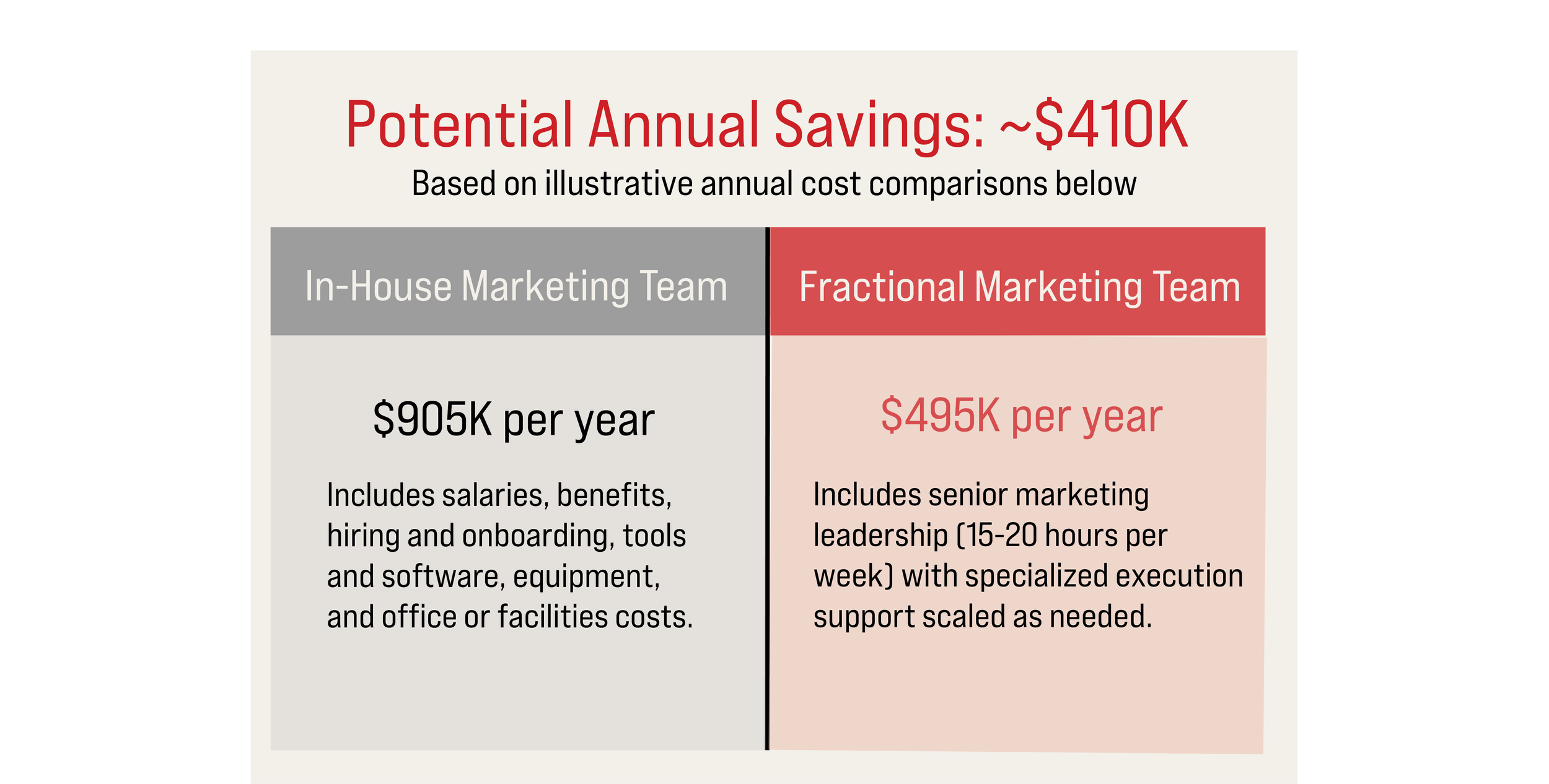
“The fractional marketing model aligns better with how growth-stage businesses actually operate.
It preserves capital, converts fixed cost into variable investment, and allows leadership and execution
to scale with demand—without locking the company into overhead the business may not need
six months from now.”
— Mike Azzarello, WingTips, Founder & CEO
The takeaway.
Travel demand is seasonal and unpredictable. Winning brands don’t rely on fixed marketing teams—they invest in flexible expertise that scales with the business.
Fractional marketing allows companies to access senior leadership, specialized execution, and strategic continuity without locking cost in place. It’s a model designed for growth-stage reality, not static org charts.
At agent.m, we help travel, hospitality, and lifestyle brands build marketing organizations that are:
Strategically led, with clear ownership and prioritization
Aligned to real business demand—not assumed headcount
Designed to maintain momentum through growth cycles and uncertainty
Structured to balance leadership depth with capital efficiency
If you’re rethinking how marketing should scale inside your business, we’d love to explore what a fractional model could look like for you.